
Introduction
The short answer is no; AI will not replace human animators. However, animators who use AI will replace those who do not.
These days, creative students, animators, and parents investing in digital education all share the same burning question: Will AI replace animators?
Undeniably, the animation industry is experiencing its most significant shift since the transition from hand-drawn frames to 3D digital rendering. Particularly with the rapid rise of generative video, automated rigging, and AI-assisted physics, the noise surrounding automation can feel alarming. However, when you cut through the internet hype, the reality paints a completely different picture.
The truth is simple: AI cannot replace animators because it lacks an independent creative mind.
As a matter of fact, AI only generates results based on the historical data and prompts you provide. Consequently, your unique creative thinking, artistic vision, and emotional storytelling remain completely irreplaceable
While AI can perform complex mechanical tasks at lightning speed, its output is rarely perfect. Indeed, having tested these tools across numerous production workflows, I have personally seen AI make critical structural mistakes time and time again. Have you ever verified if an AI-generated action looks truly natural? Assessing the physical accuracy and emotional depth of a scene ultimately requires an experienced professional. Therefore, without human quality control, the final artwork compromises studio standards.
In short, AI was never meant to replace human artists. Instead, it was created to handle the repetitive work, make your tasks easier, and save production time. Here is why the future of animation careers is brighter—and more tech-driven—than ever before.
AI vs. Animation Jobs: Will AI Replace Animators?
The short answer is no, AI will not replace human animators. However, animators who use AI will replace those who do not.
To truly understand why AI cannot replace creative artists, we have to look at how these systems actually work. AI is fundamentally a professional tool that operates entirely on historical, stored data. It cannot think independently.
For instance, an AI model will confidently tell you that water is black if you ask it, “What is the color of water?” and the broad internet data it retrieves happens to incorrectly state that water is black. It merely extracts patterns from previously published human-written articles, forums, and blogs. It doesn’t understand; it just repeats.
This algorithmic limitation means that AI is completely devoid of real human experiences, cultural subtleties, or intentional emotional depth. Fundamentally, animation is a performance. It is a story. An artificial intelligence can calculate a smooth flow of motion mathematically, but it cannot understand the reason why a character pauses, then decides something, or how a subtle twitch of the eye can show heartbreak.
AI is not replacing the artist but acting as a hyper-efficient studio assistant. The industry is quickly shifting from chaotic “text-to-video” generation to intent-based pipelines. In this new workflow, the human artist keeps full creative and logical control, while machine learning simply does the repetitive, mechanical heavy lifting.
The AI Animation Tools That Are Changing the Industry Pipeline
Modern production studios are actively integrating specialized AI tools to eliminate technical bottlenecks. Rather than taking away jobs, these technologies allow smaller teams to execute massive, cinematic-scale projects at lightning speed.
Here are the revolutionary tools reshaping studio workflows:
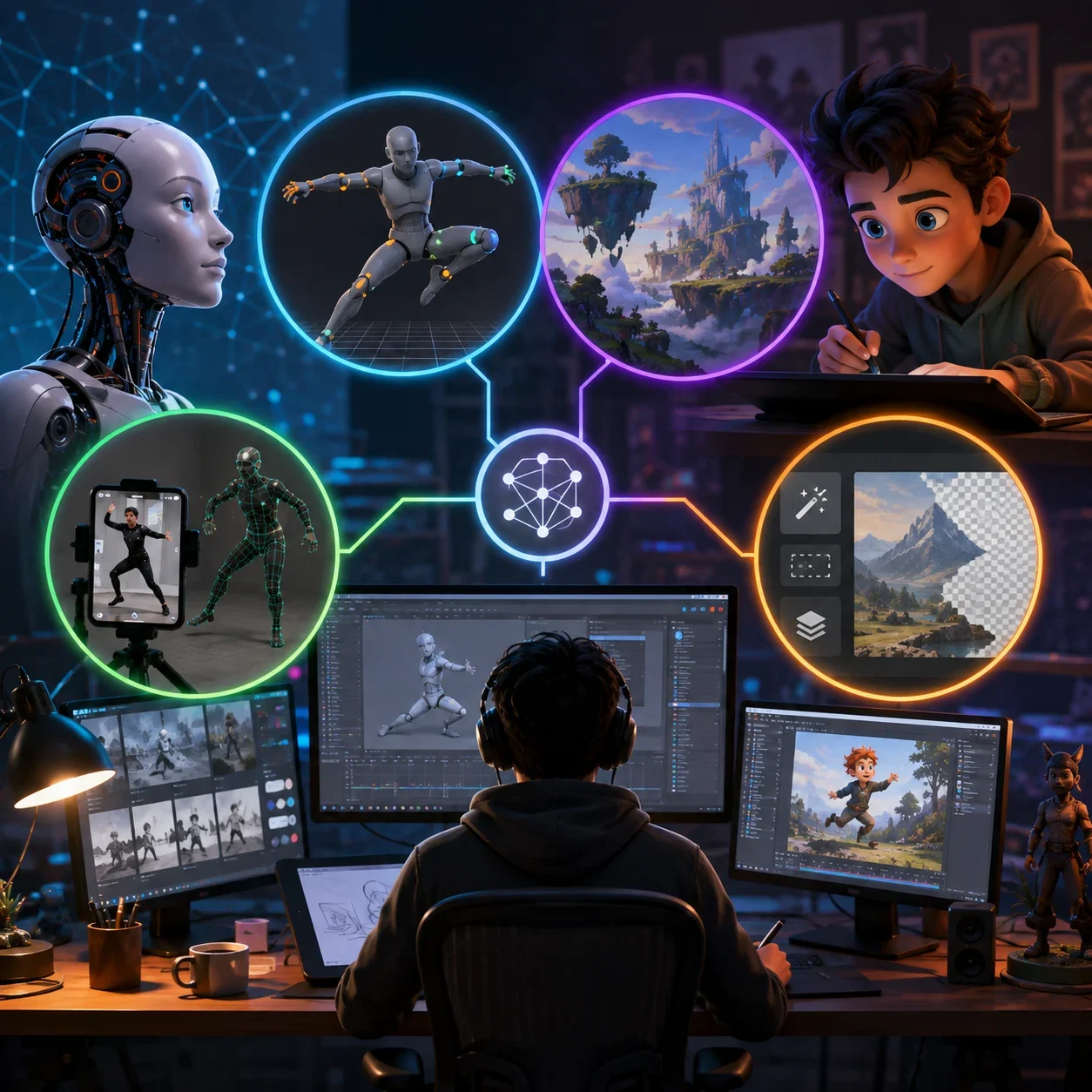
Cascadeur: Physics-Based AI Animation
This software uses physics-based AI to automatically calculate realistic weight, center of mass, and joint positions. Thus, it saves animators hours of manual keyframe tweaking while keeping the artist in full control of the character’s pose.
Runway Gen-3 Alpha: Rapid Pre-Production
This tool is utilized heavily in pre-production for rapid style framing and mood boards. Specifically, it allows concept artists to generate dynamic background elements and visual textures from simple directorial inputs.
Deep Motion & Rokoko Vision: Markerless Motion Capture
These tools enable markerless motion capture. As a result, animators can now extract complex human body movements straight from a standard smartphone video, completely bypassing the need for expensive studio suits.
Adobe Firefly & Sensei: Smart Asset Automation
These systems are deeply integrated into standard design tools like Photoshop and After Effects. Furthermore, they automate time-consuming tasks like object removal, smart masking, and asset vectorization with a single click.
Human Animators vs. Artificial Intelligence: Who Holds the Creative Edge?
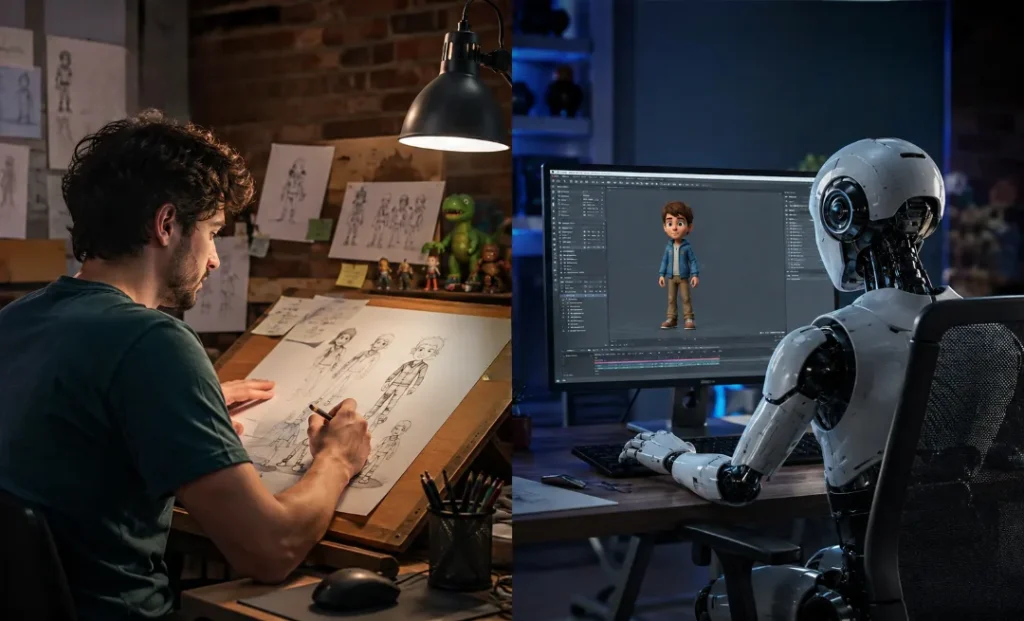
As someone who works closely with these digital tools, I can tell you firsthand: there is a massive difference between a technically smooth AI generation and a true, emotionally moving piece of animation. While AI tools excel at raw computation, they completely fall apart when it comes to the nuances of artistic expression and consistency.
Simply put, AI hits a wall where it can no longer be creative. When you attempt to generate assets repeatedly across a timeline, the system begins to loop, hallucinate, and break down. Over time, AI starts generating images and videos with random aspect ratios, mismatched facial expressions, and highly unnatural character defects.
The Myth of the Perfect Prompt
Now, critics might argue that if you just write a better, more advanced text prompt, the machine will deliver perfect studio results.
As someone who knows prompt engineering and has tested various generative AI video models across multiple design tasks, I can tell you that this is a myth. I have experienced it firsthand: even when I write a completely correct, highly detailed, and optimized prompt, the AI eventually outputs broken, unnatural assets that cannot be used in a professional pipeline.
An AI doesn’t understand anatomy, weight distribution, or character psychology. It doesn’t know that a character’s posture changes based on whether they are happy, tired, or hiding a secret. It just glues pixels together based on mathematical probabilities.
Without an experienced human animator to fix these rendering bugs, manage the keyframes, and inject real emotional weight, the final output looks robotic and completely compromises professional studio standards.
Let’s use a table to illustrate the distinctions between human animators and generative AI.
| The Big Picture | Human Animator (The Artist) | Generative AI (The Assistant) |
| The Mind | Brings original vision, soul, and emotional acting. | Has zero logic; only spits out what is already on the web. |
| The Look | Keeps character shapes and faces perfectly identical. | Gets confused over time, making assets look unnatural. |
| The Control | Perfectly executes complex or highly detailed briefs. | Often ignores crucial parts of a detailed text prompt. |
| The Check | Instantly spots weird physics, broken weight, or bad anatomy. | Blindly renders mistakes without knowing they are wrong. |
| The Purpose | Thinks, creates, and connects with the audience. | Speeds up boring chores like rotoscoping and cleanup. |
How AI Is Reshaping the 3D Animation and VFX Pipeline
AI is completely obliterating tedious studio chores. Advanced neural networks now automate repetitive, non-creative bottlenecks like character auto-rigging, markerless motion capture cleanup, and frame-by-frame rotoscoping. Additionally, artists can quickly upscale low-resolution scenes into sharp 4K by using AI-driven rendering and clever denoising, which saves hundreds of machine rendering hours.
Future-Proofing Your Career: Why Traditional Animation Skills Matter More Than Ever
Because technical barriers are lowering, raw creative mastery has skyrocketed in value. To stay unreplaceable, you must deeply master traditional core fundamentals like the 12 principles of animation, physics, and genuine character acting. True success means building a hybrid skillset—combining solid artistic taste with the technical fluency needed to direct next-generation AI workflows.
Step Into the Future of AVGC with Arena Animation Indore
The global AVGC sector is expanding, and studios want professionals who can pilot advanced pipelines. At Arena Animation, Vijay Nagar & Bhanwarkua, Indore. Our 100% job-oriented programs train you using high-end software, VFX Chroma Studio, and real-world AI-assisted workflows.
Conclusion: Secure Your Creative Future
Ultimately, the question is not whether AI will replace animators, but how quickly human animators can learn to master these new tools. While algorithms can speed up mechanical tasks, they completely lack the soul, original vision, and emotional acting required to tell a truly moving story. The future belongs to hybrid artists who combine traditional animation fundamentals with next-generation technical fluency.
Ready to lead the next era of design? Book your free career counseling session at Arena Animation Indore today and build an irreplaceable skill set.
Frequently Asked Questions (FAQ)
No. AI lacks an independent creative mind, emotional storytelling depth, and human experience. It functions as an assistant, not a replacement.
Software like Cascadeur for physics tracking, Runway Gen-3 for pre-production style framing, and DeepMotion for markerless motion capture.
Humans understand character psychology, subtext, subtle emotional performances, and anatomical consistency across complex storytelling timelines.
Master the traditional 12 principles of animation, focus on genuine character acting, and learn to pilot advanced AI automation workflows.